quarryPhysiotherapy_L55may13

Image | Posted on by | Leave a comment

Relaxed mind equals a relaxed body

Ceder Finnie Fitness Plus

Ceder Finnie
Fitness Plus

Close your eyes, take slow deep breaths in through your nose and out through your mouth. Try to imagine a warm, comforting bright light filling you – starting in your toes and making its way up your legs into your stomach, through your chest and finally spilling from the top of your head and out of your finger tips. As the warm, comforting light leaves you it takes all your stress, all your negative emotion and leaves you feeling cleansed and joyful.

Now that you’re feeling relaxed, we continue our morning workout, adding of course to the exercises we’ve already been doing. Building on the “plank”, which we worked on last month, (see video at the below address), we are ready to go into the side plank after lying face downward toward the ground for one minute.

From the plank position, roll onto your side, balancing on the one foot and arm still on the ground. Extend your free arm straight above you as if reaching for the sky; hold for three minutes.

Re-centre (back in the plank position) and hold for one minute, then switch to your other side for three minutes, returning to the plank position. This will continue the strength-building of your core and start to visibly define your muscles more clearly.

Once we’ve completed the series of planks we will move into crunches, or situps.

There seems to be a lot of confusion as to what a proper crunch is. In my opinion a proper crunch is one that offers no chance of injury. Lie on your back, knees bent and toes pressed firmly against a wall if possible, or even under a couch. This will stop your legs from extending.

Here is the part that gets confusing: To do a crunch and ensure you have no injuries, your back must be completely straight. Lift your upper body off the ground using only your abdominal muscles. Stop well before your head reaches your knees and hold for the count of five. Lower your body back down but not allowing your back complete contact with the floor. This will keep your core (abdominal) muscles tensed and supportive. Repeat this
motion 15 to 30 times, depending on your stamina.

Your long term goal for crunches should be to do 100 in a row. It may be some time before you can accomplish this. However, that will be time well spent.

Jumping Jacks was our cardio workout previously, and truly a whole lot of fun! This month we will become even more in tune with the inner child that’s just bursting to get out.

We have all skipped rope at one point or another. I don’t expect everyone to have a jump rope lying around, so we will make do with an ordinary piece of rope. Again, please only push your body as much as it will allow. If you have bad knees or any injuries, please adjust to a pace and height that is comfortable for you. Fun fact: five minutes of skipping is the equivalent of a mile-long jog.

I’ve talked about the importance of the morning routine; our night routine is equally important. Finishing off your day in the same manner as you started it, with a healthy meal, can make all the difference in the world to your well-being.

One of my personal favorite meals is either boneless, skinless chicken or turkey breast. Combine extra virgin olive oil and spices of your choice, lightly baste the poultry and roast in the oven. When it’s about half-way cooked, lightly baste one more time.

Serve the cooked poultry with some delicious fresh vegetables, and enjoy your meal.

Do you have a question about fitness matters? Whether it’s about the safety or appropriateness of the exercise you’re doing, about a safe, effective exercise to meet your personal body needs, or perhaps about a food and its nutritional value, ask Ceder Finnie.

Ceder is Western Canada female champion in light-weight mixed martial arts and has a rich knowledge in matters related to body fitness. She invites you to email your queries. She will answer the questions in future columns.
(Ceder will take you through the exercises in the March to May issues on our website. The columns are at: http://lifestyles55.net/category/fitness-plus.)

Posted in Fitness Plus | Tagged , , , , , , , , , , , , , , | Leave a comment

Pets dispense love, health to humankind

Pets can provide mental stimulation and give us a sense of being needed.

Pets can provide mental stimulation and give us a sense of being needed.

For many years, health care providers have recognized the benefits of interacting with pets, a process often referred to as “pet therapy”. As long ago as 1860, Florence Nightingale commented that “a small pet is often an excellent companion for the sick, for long chronic cases especially”.

Pet therapy has been studied on heart patients, children and seniors, as a way to promote quality of life and provide positive health benefits. According to a recent article in Wave, Winnipeg’s health and wellness magazine, the company of an animal can lower blood pressure, cholesterol and a triglyceride level, in turn helping manage heart disease.

The same article stated that people with dogs or cats tend to have better recovery rates from heart attacks. Pets can also help people better cope with depression and stress-related disorders. Of course, there are scientific reasons for this. Stroking a pet releases feel-good hormones in the body, such as serotonin, prolactin and oxytocin, which help people relax.

Pets are used in many therapeutic situations. Pet therapy can provide support for people with physical disabilities and provide companionship to people with mental health challenges. In many personal care homes, pet therapy is common.

If you have ever owned a pet, you know the benefits (even if you don’t look forward to walking the dog in minus 30-degree weather):
• Pets provide humans with love, affection and companionship.
• Pets can encourage good health through regular exercise.
• Pets can offer a sense of security and protection.
• Pets can help us relax and make us laugh.
• Pets can provide mental stimulation, reduce loneliness and give us a sense of being needed.
• Animals can be a conversation piece, helping us to make friends and socialize.
• Animals are good listeners, are non-judgmental and will keep all discussions confidential.

Not everyone, however, is in a position to own a pet. If owning a pet is not an option, consider volunteering at an animal shelter. In addition, some programs bring animals to people in places where pet ownership may be restricted. The St. John Ambulance Therapy Dog Services brings a volunteer pet-handler and their dog to hospitals, seniors’ homes, schools, health care facilities and other places. They visit people of all ages who can benefit from the unconditional love of dogs. Partnerships in these settings make therapy dog visits easy and regular.

For more information about becoming a volunteer, or having visits, call the St. John Ambulance Manitoba office: in Winnipeg at 204-784-7000; email, info@mb.sja.ca; or St. John Ambulance Brandon office at 204-727-4466; email, info.brandon@mb.sja.ca.
Age & Opportunity support services for older adults also offers its Paws with a Cause therapy dog program. This program matches older adults with volunteer visitors in partnership with St. John Ambulance therapy dogs. For more information, contact A & O support services at 204-956-6440 in Winnipeg.

If you are looking for a place to rent for you and your pet, I encourage you to read the renting with pets section on the Manitoba government’s Residential Tenancies Branch website at http://www.gov.mb.ca/cca/rtb/. In addition, for information on the province’s new pet damage deposit, please contact the Residential Tenancies Branch at 204-945-2476; toll free 1-800-782-8403; email, rtb@gov.mb.ca.

The Winnipeg Humane Society has a list of pet-friendly apartments in Winnipeg on its website at http://www.winnipeghumanesociety.ca/pet-friendly-housing. Landlords with pet-friendly buildings can contact the society at 204-982-3555 or lindsayc@humanesociety.mb.ca to be added to the list.

As always, I invite you to contact the seniors information line with any comments or questions. Call 204-945-6565 in Winnipeg; toll free, 1-800-665-6565.

Hon. Jim Rondeau is Minister of Healthy Living, Seniors and Consumer Affairs.

Posted in Furry Friends, Health | Tagged , , , , , , | Leave a comment

Noise pollution is making some of our dogs phobic

We have smoke alarms, burglar alarms, car alarms, personal alarms, and even some startling cell phone ring tones – and when harsh sounds scare our dogs they often have no way of escaping to a quiet place. The effect can be thoroughly unnerving.

When we think of dogs and noises we usually imagine dogs barking incessantly, causing a disturbance. However, the reverse is also true. Dogs can be frightened, sometimes dangerously so, by noise, and our ever more noise-polluted environment is creating some significant physical and psychological challenges for our canines.

Wild dogs, including wolves, will usually head in the opposite direction to a loud noise. As thunderous clouds approach, the animals make a hurried exit away from the storm. They have learned that if they run far enough they eventually will find peace.

Not so for our pets. First, they are exposed to an ever increasing number and variety of harsh, chilling sounds. We now have smoke alarms, burglar alarms, car alarms, personal alarms, even some cell phone ring tones that to a dog can be unnerving. But unlike wild dogs, our pets are confined. Imagine a dog alone in a house when a smoke alarm or burglar alarm goes off. The dog will instinctively want to escape but be unable to.

Can be damaging

Worse, what if that dog is kenneled? He can’t even hide. Even in a back yard, a dog cannot flee from a frightening sound. Many have tried to dig their way out. And, of course, a dog locked in a car when the alarm goes off will often claw viciously in an attempt to get out. The inability to escape this uncontrollable terror can lead to serious physical injury and long term psychological problems.

The impact loud noises have on our pets is often difficult to assess. Not all dogs respond similarly to startling noises. A few become hyper-vigilant but most will instinctively try to flee. It is when a dog starts to generalize his fear of noises to the point that almost any loud or unusual sound causes a panic that the dog is considered to be noise phobic.

Some owners think that they merely have a nervous or skittish dog. Some say their dog is just a baby or a coward. But if a dog trembles, urinates, defecates or goes into a blind panic at sudden sounds, the reaction is more than just a dislike of noises.

Left untreated, noise phobias invariably get worse. Some breeds, notably the herding breeds, may be predisposed to the affliction and it appears that dogs who suffer separation anxiety may also be more prone to noise phobia.

If you suspect that your dog is developing a noise phobia, you have to be careful not to reinforce this fear. Although you may want to, you should not overly comfort and pet your dog in such situations. The dog will see this as a reward and also confirmation that the situation requires comforting. Likewise, don’t scold or mock the dog for being afraid, for this will only add to the anxiety of an already anxious situation.

Drugs ease the anxiety

Dogs are pack animals so if you, the leader of the pack, remain calm and confident, the dog will have some reassurance that you are in control of the situation. Your easy-going manner and relaxed demeanor can provide guidance for your dog’s reaction.

Moderate to severe noise phobias require more proactive approaches. Since no one strategy is successful for all dogs, professional help is usually recommended. The most common approach is to attempt behavior modification. These techniques try to desensitize the dog to noise in order to extinguish the overreaction.

Environmental controls, where you try to eliminate as many noises as feasible, may also help. Finally, drug therapy is frequently included in treatment. Medication can include different classes of drugs such as anti-anxiety, antidepressants and tranquilizers. You might also consider natural, herbal remedies.

It is important to understand the difference between the normal fear of loud noises a dog expresses and fear that has become pathologic. You know your dog best and if you sense that your dog overreacts to noises, then consult with your vet. Remember, a noise phobia left untreated will only get worse and may result in permanent physical and psychological damage.

Animal lover Robert Urano was longtime operator of a Winnipeg pet food store.

Posted in Feathered Friends, Furry Friends | Tagged , , , | Leave a comment

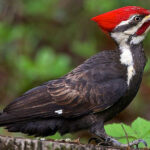
Red-crested and very vocal, the amazing pileated woodpecker is making itself known in our area

Up to two feet high, they mate for life, use their bills to create nesting cavities in mainly hollow trees and can be heard drumming at a furious pace on other trees to claim their territory.

This woodpecker's loud and vocal, and fun to watch.

This woodpecker’s loud and vocal, and fun to watch.

Everyone who feeds wild birds takes great pleasure in seeing a new species at their feeders. There’s nothing more thrilling than attracting a rare or unusual bird. At those moments you don’t want to move to scare the bird away, yet you want to go get the camera to have proof of your sighting!

I tend to gasp or perhaps yell a joyful profanity (there is such a thing!) when I have been treated to a special sighting. My dog Sila has now caught onto these reactions and jumps to the window to scare everything away. I’m working on saving the strong gestures until I’ve taken a picture, but now Sila identifies the camera with something at the window. I’m a bird girl not a dog trainer, clearly!

One local bird that brings out extreme reactions from people is the amazing pileated woodpecker.

Everyone knows the cartoon bird Woody Woodpecker, which is a characterization of a pileated woodpecker, a loud and vocal bird that garners a lot of attention when it appears. These large birds are about 20 to 24 inches high with a great wingspan of 26 to 30 inches. The most notable trait other than their size is the crimson red crest on the top of their heads.

Unlike other woodpecker species both male and female pileateds have the crest, with the male identified by an additional red stripe across its cheek. They have very strong bills measuring about 2.5 inches in length which is used to excavate nesting cavities in dead trees and to aid in foraging for insects.

Pileated woodpeckers have a wide diet consisting of ants, wood-boring beetles and their larvae, along with fruit, nuts, and berries. One berry they really enjoy is that of the poison ivy plant. Pileateds can often be seen attacking dead trees to dig for food, drum for territory or excavate a cavity.

Nesting begins in April when the male begins to create a cavity in a tree to attract a female. Once a pair has bonded they will mate for life. The female lays three to five eggs and both parents will incubate the eggs for 12 to 16 days. After 24 days the young will fledge and the nest is abandoned.

Pileateds do not return to the same nest each year, but the cavities serve many other species for years to come. Smaller songbirds will use the cavities as a roost in winter and other birds like wood ducks and screech owls will nest there.

Recordings of pileated woodpeckers have them drumming for territory at a count of 16 beats per second! They usually drum on dead hollow trees to maximize the sound. Their territory can be as small as 1,000 acres in suburban areas or up to 4,000 acres in the deep forest. Pileated woodpeckers will tolerate other pileateds in their territory during winter, but in summer the birds fight many battles, by dive-bombing, striking each other with their wings and even jabbing with their powerful bills.

Pileated woodpeckers have been making an amazing number of appearances at birdfeeders throughout the city and rural areas. I am astounded at the number of reports we have been getting over the past few years. My first sighting was last summer early on a Sunday morning as I was leaving to appear on Dorothy Dobbie’s radio show, The Gardener. I abandoned the beautiful sight to get to the studio for the live show, but not before taking a photo.

The suet log feeder is the most successful feeder to attract pileated woodpeckers. These natural logs packed with suet are renowned for luring these magnificent birds into backyards. We have even had reports of adults bringing their young to the feeders.

There is a summer and winter version of the suet. It’s filled with nuts, crickets, and mealworms and also caters to smaller woodpeckers, nuthatches and chickadees, along with orioles and robins in the summer!

Try attracting this special bird to your yard, just don’t let your dog beat you to the window.

Sherrie Versluis owns The Preferred Perch; call her at 204-257-3724.

Posted in Feathered Friends, Feature, Out & About, Uncategorized | Tagged , , , , , , , | Leave a comment

He’s losing his marbles – one by one!

There are times when we age that big decisions have to be made. But as long as there are marbles left in Doug Mackie’s big jar, he doesn’t have to face the hard realities his daughter proposes to raise with him.

This simple jar of marbles  is an excellent time keeper.

This simple jar of marbles is an excellent time keeper.

By Doug Mackie

As we age, many of us tend to put off making decisions until they are made for us by others. Where can/should I live? When should I stop driving? It would be beneficial to all concerned if some planning were done now for the future, and we were involved.

I am male, 72 years old, prostate cancer survivor, six children aged 21 to 48. I am very active in the community. My children live in Vancouver, Saskatoon and Winnipeg. My younger children aged 21 and 23 will likely move elsewhere when their studies are completed.

I have hobbies which keep me busy. I preserve jams and jellies, about 250 jars last year, and take photographs which I make into everyday cards.

Setting a deadline

I am very involved with Mensheds Manitoba Inc., a volunteer grassroots organization run by experienced men for men. Mensheds has programs for men that keep them busy, shoulder to shoulder, pursuing their hobbies or short-term volunteering in the community. Men keeping themselves active makes for healthier relationships at home and in the community, and allows men to “feel better” about themselves.

Last summer, one of my daughters said to me, “Dad, you have until you are aged 80 to get everything done you wanted to do. Then we are going to sit down and decide together where you are going to live. I don’t mean you have to stop doing your various activities but let’s set a line in the sand now to have that open and frank discussion.”

I loved the idea! Decision time is far enough away not to be an immediate threat. After all, change can be intimidating and somewhat disturbing. This conversation, initiated by my daughter, has opened my mind to realize that life does change and how we can plan for the future now.

Well, about losing my marbles! I have a large jar where I have placed several hundred marbles. Each individual marble represents a Saturday between now and my 80th birthday. Every Saturday, I take one marble out of the jar and leave it somewhere during the day. When there are no more marbles in the jar, it will be decision time to make a plan for the next 10 years of my life.

Sounds simple, just lose that marble in the grass or out the car window. But that does not seem to be the case for me. Each Saturday as I reach into the jar for my next marble, to lose, I realize that another week has gone by. I reflect on the past week and what the following week may bring. I find this centering and mentally healthy.

So where have I lost my marbles so far? One was placed in a “squirrel’s hole” in an oak tree in my front yard. Another was dropped into a creek near where I live. While I was visiting with my grandchildren in Saskatoon, one was placed on top of a sign downtown. The children loved doing this with me!

Booking time

A marble was left behind a bookcase in the Manitoba legislative building.

One has gone to Burundi and another to Cambodia. How so, you ask? Well, I was at International Hope Canada on two Saturdays. IHC was shipping a container of reclaimed medical supplies to these countries. What will someone there wonder about the marble they will find in a box of rubber gloves or in a box with a surgical mask. Will the finders take that “lost” marble home to a child? I hope so.

Losing my marbles has turned into an exciting time for me. Each Saturday I have a challenge and a task. The next time you find a marble, remember what it represents to me.

If any of you have a bag of marbles at home which you no longer use, I am still a few hundred short in my jar!

Posted in Feature, Health | Tagged , , , , | Leave a comment

Welcome little Hudson; this bear has big bear shoes to fill

At least three-fifths of the world’s polar bears – 15,000 of them — make their home in Canada. However Hudson’s predecessor – the beloved Debbie – was a Russian immigrant, arriving at Winnipeg’s zoo around 1967.

The Assiniboine Park Zoo welcomed little Hudson to their family earlier this year.

The Assiniboine Park Zoo welcomed little Hudson to their family earlier this year.

I have had a love of polar bears since I was a small child. To observe this magnificent animal against a backdrop of white snow and ice is to enjoy a glorious sight.

People in other parts of the world have a fascination with our polar bears, too, and wonder how this animal can survive in such a harsh environment. They probably have the same question about us Manitobans. Like polar bears we have had to learn to adapt to our cold winters. Growing up on the prairies, we played outdoor games and made the most of our winter season.

Layers of hair for warmth

We have adjusted to our cold climate by learning to layer our clothing on a cold day. We wear our “polar fleece” clothing to keep warm and fend off the big chill. Polar bears essentially layer as well. They have two coats that cover their black skin to protect it. They have a fuzzy colorless undercoat (think of it as a polar bear’s long johns) and over that is a thick long covering of guard hairs which are also colorless.

The undercoat traps air next to the skin and the long hairs, which are like tiny straws, repel water. This layering helps to keep the bear warm and dry.

We Manitobans, too, prefer a “dry cold” and can feel chilled when we have a “damp cold” day in winter. Thankfully we don’t have to plunge into cold water in winter to get our food.

Did you know that a polar bear’s paws can measure up to one foot across? These large paws help to distribute the huge amount of weight the bear carries when it’s running across the frozen tundra. This would be somewhat like our wearing snowshoes to move quickly across the snow.

The sheer size of the polar bear is intimidating, but as a child I thought the little ears and tail made the bears seem cute. I didn’t know there was a practical side to these features. Small ears and a small tail mean there is less surface area to keep warm, and the bear is therefore less prone to heat loss. Bears have another special attribute working for them in the northern existence: an incredible sense of smell. They can pick up the scent of a seal from 20 miles away.

According to Environment Canada our country is home to approximately 15,500 of the estimated 20,000 to 25,000 polar bears in global polar regions. Churchill has earned its nicknamed as the “Polar Bear Capital of the World”.

Live into their teens

The polar bear’s normal lifespan in the wild is 15 to 18 years, though some bears have been tagged in their early 30s, both in the wild and in captivity, and Winnipeg had the distinction of having in captivity the world’s oldest polar bear. Born the in the Soviet Arctic in 1966, Debbie was an orphan when she came to Canada at the age of one. Debby lived to age 42 at the Assiniboine Park Zoo; she was diagnosed as suffering from multiple organ failure and euthanized.

Hudson, a 15-month-old polar cub born in captivity at the Toronto Zoo is the first polar bear to inhabit the newly opened polar bear conservation centre at the Winnipeg zoo. Both this centre and the “Journey to Churchill” exhibit, set to open in 2014, will be integral to research, environment education and conservation of polar bears and other wildlife.

I encourage you to welcome Hudson, our new Manitoban, by visiting him at the Assiniboine Park Zoo. For more information please check the zoo website at http://www.assiniboineparkzoo.ca.

Myrna Driedger is MLA for Charleswood and deputy leader of the provincial Conservative party.

Posted in Announcements, Feature | Tagged , , , , | Leave a comment