
The world is looking to Canada’s north and particularly its connection to tidewater. In mid-September, the Frontier Centre is hosting an important symposium, Reclaiming the North: Strategic Utility Corridors for Sovereignty and Economic Development in Canada’s Arctic, to explore options. Robyn Lore of NeeStaNan is one of the presenters, and will explore the value of making informed and rational decisions about the best way to realize our potential.
There can be little doubt about the value of opening Canada’s most accessible northern gateway to tidewater through Hudson Bay. The deal is not only doable but imperative.
The original choice for a port was at the mouth of the Nelson River, very familiar to ocean-goers as the first entrance point to central North America. Even though the Port Nelson site was much closer to the new capital of Winnipeg, reachable by building a railroad over hard ground, it was moved to Churchill despite access impediments – the spongy permafrost that is still a barrier to its success today. After building the basics from 1911 to 1918, due to politics and war, the idea and the work were abandoned and resurrected a decade later, but redirected to Churchill.
The Churchill advantages
Churchill never lived up to its promise as a port of any significance.
That doesn’t mean that Churchill should be abandoned. It does mean that the two ports should act in concert, providing backup and support for each other.
By working together, shippers will have important reassurance that there is an alternate route should something happen to either. Meanwhile, each location must rationalize its best use and focus on that.
Churchill has spent the last several decades turning itself into a worldwide tourist destination. The Bay teems with wildlife. Belugas are born in the freshwater of the river. Seals congregate here in fall, seeking out the food that is being swept to the surface at freeze-up.
This attracts Polar bears, who depend on the fall seal hunt to get them through the winter. It is a perfect ecosystem for wildlife which attracts tourists. However, the conditions that make this possible also present difficulties for shipping. Freshwater freezes solidly, great for the bears when stalking seals, but not so great for ships that need that ice broken up to navigate the harbour in winter. Doable with icebreakers, but what of all that wildlife?
Secondly, the port is much too small to accommodate today’s transport ships. While the port at Churchill was built to berth two ships at a time, that is no longer possible. Even ordinary carriers have grown in size. There is just no way Panamax or larger ships could squeeze in here.
So, what to do with Churchill? I think it has answered this with its natural progression towards tourism after the Americans pulled their military base in 1980. But, imagine what could happen if the port were rebuilt to properly accommodate cruise ships as well as supply vessels to service Nunavut, which is growing at a record rate.
As for the town, imagine taking a page from the Wally Daudrich playbook and making it picturesque with location-appropriate buildings and highlighting the lovely, quirky things that are part of the Port’s identity? One of the things I love is the “weather station”, a tiny park featuring local weather wisdom such as, “If the rock is wet, it’s raining!” The folks here have a great sense of humour.
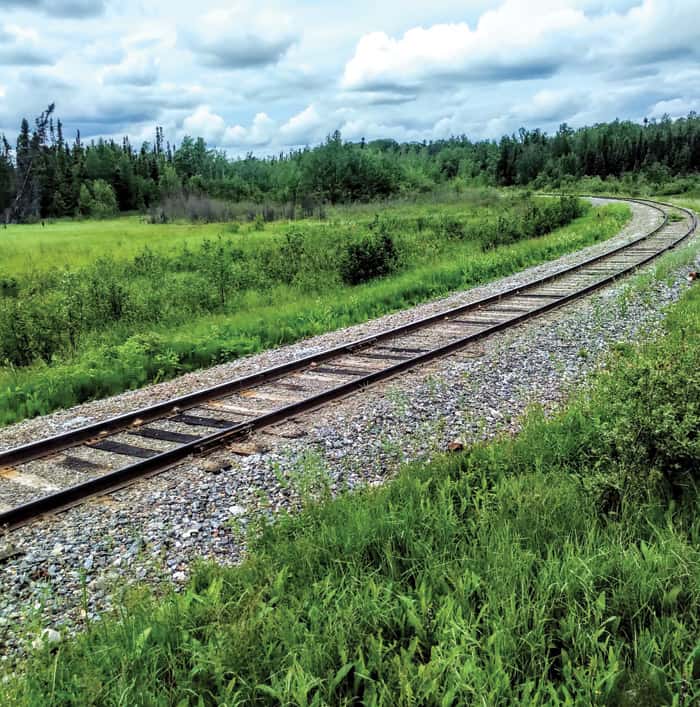
As for the railroad, it has been in operation for almost 100 years, but it has had a chequered history. First, it takes the scenic route from Winnipeg, West to Dauphin then further west to Saskatchewan, sling-shotting back east through The Pas to Thompson and then up to Churchill.
The leg of the trip is the most picturesque. I would counsel people to drive to Thompson and hop on there for the last 16 hours. If VIA Rail had any imagination, it would add a couple of first-class tourist cars – complete with dining cars and berths, (which are never available) for a unique luxury experience.
Capitalize on the stunning scenery and the romantic rail cars swaying over the muskeg, making it part of the uniqueness.
Churchill has a wonderful future if its true advantages are respected. Let Port Nelson handle the other side to feed the coffers of Manitoba and Canada.
Port Nelson advantages
Let’s list them:
• A hard-bed road to the Bay so trains can run at speed.
• An all-weather road from Winnipeg to Amery, so adding another 120 km would not be a big deal.
• Saltier water that doesn’t freeze to a depth of five or six feet,
• Fewer bears in the vicinity.
• The ability to ship all year long with just reinforced-hulled ships in the Bay and icebreakers needed in Hudson Strait.
• An offshore terminal that will avoid the belugas who give birth in the fresh water coming out of the river, avoid the silt, and could accommodate Panamax-plus-sized ships.
• And, perhaps most important of all, Port Nelson, NeeStaNan, will have true Indigenous majority ownership with experienced partners walking alongside them. This provides real economic opportunity for previously isolated and deprived communities, opening the door to true economic freedom and reconciliation.
Let us not forget the internal advantages for our province and our country. While all eyes are on oil and gas these days, critical minerals are just as important, and a ready port with a rail line that could accommodate the heaviest loads would be an added incentive to development. According to our Finance Minister, Adrian Sala, a special concierge system has been created to advance projects rapidly. He says several new mines are apparently in the works.
But there is also a huge market for moving the said oil and gas from Alberta, potash from Saskatchewan (and soon from Manitoba), agricultural goods from all three provinces, manufactured products such as heavy farm equipment, fire trucks, buses, mining equipment, commercial trailers and vacuum cars, agricultural storage bins – the list is endless.
And so is the market. There is interest in northwestern Ontario and the Ring of Fire. There is also a vast market in the Midwestern USA, which is just as land-bound as central Canada.
NeeStaNan, Port Nelson, has not gone away. It is just picking up steam. The Port will be built, and Churchill will be happy.