
By Dorothy Dobbie
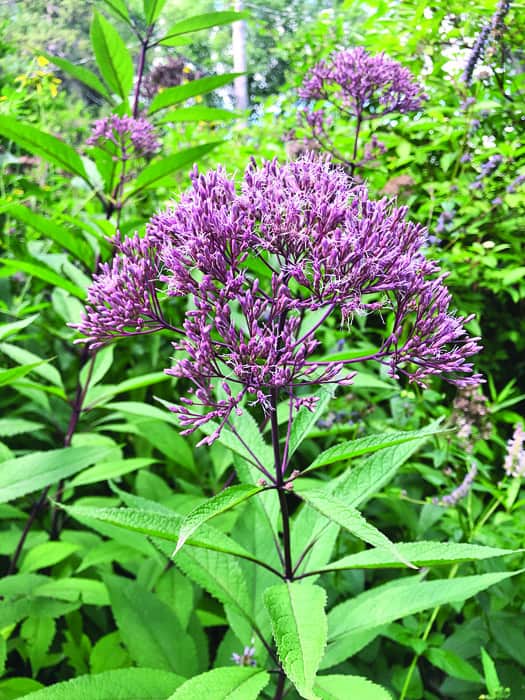
I had heard of and seen Joe Pye weed throughout my gardening life, but I did not learn to respect it until I saw it taking pride of place in a lovely English garden. It was tall and imposing, showing off its purple and dark green leaves and in full rosy bloom, buzzing with bees. I fell in love.
Joe Pye Weed is the common name for Eupatorium. This versatile plant has many qualities and therefore has a long list of common names: boneset, kidney root, gravel root, snake root, and thoroughwort, to name a few. In the early days, various types were used medicinally to treat infectious diseases carried by ticks, lice, mites and rat fleas. It was used to treat fever, headache, rashes, rheumatism, gout, breathing problems, and diarrhea.
The name Joe Pye weed is attributed to a Mohican named Joseph Shauquethqueat, known to settlers in New England as Joe Pye. He saved a community from death by typhus using E. purpureum, whose leaves, flowers and roots are all useful. The plant contains flavonoids and euparin, a mild antioxidant.
Today, we grow Joe Pye weed for its ornamental value and because it is pollinator-friendly. Goldfinches love to feast on the seeds produced at the end of the summer.
It is also a forgiving perennial in the garden, blooming for about six weeks but, under the right conditions, up to ten weeks. It likes sunlight to light shade in rich, moist but well-drained soil conditions. It is not that fussy and will generally grow wherever you put it. However, that beautiful specimen I saw in England was responding to some garden empathy. I would suggest giving it lots of water because in the wild, it thrives at the margins of sloughs and wet ditches.
Joe Pye is generally a large plant that can create a four-foot-wide clump, so if you have a small garden, there are now dwarf varieties you can grow. You can also cut back stems to half in June, which will result in a shorter plant with more stems and more flowers.
Good plant companions include Karl Foerster grass, Echinacea (purple coneflower), Helenium, Monarda and Persicaria.
Spotted Joe Pye weed, E. maculatum, when wet and happy, can grow to eight feet tall. This is the one with the fluffy flowers. It is one of the very long bloomers, putting out umbels that can, in some species, get as large as eight inches across.
On the other hand, Sweet Scented Joe Pye weed, E. purpureum, is often confused with spotted Joe Pye weed, but it has regular blossoms and smells like vanilla.
Hollow Joe Pye Weed, E. fistulosum, is the tallest of the Joe Pye Weeds, reaching 10 feet tall and sending out whitish-pinkish flowers in late summer to early fall. Leaf cutter bees will overwinter in its hollow stems.
Clearly, Joe Pye weed is best loved by those who like large plants and love to attract pollinators and birds.