Part one of a six-part series
By Greg Barrett
“Can a woman forget her nursing child, Or show no compassion for the Child of her womb? Even these may forget, Yet I will not forget you.” (Isaiah 49:15)
There was a buzz of anticipation among the Italian seniors on that 15th day of November 2023. My wife, Erina, and I had just completed a brief presentation in preparation for the seniors’ visit to the Shrine of Vasyl Velychkovsky, Bishop and Martyr, at St. Joseph’s Ukrainian Catholic Church in North Winnipeg.
As we concluded our presentation, a gentleman in the group who had obviously been paying close attention asked to speak to us. When he approached us, he had one question: When did Bishop Velychkovsky come to Winnipeg? When we told him that the bishop arrived here on June 15, 1972, the man replied in a voice full of emotion, surprise and awe, “I know this man!”
With an emotional intensity born of tightly held memories, Romolo Fracassi told us his story. Romolo was born in 1935 in the town of Pescina, Province of Abruzzo, Italy. He was apprenticed as a tailor and became fully trained in the time-honored skills of his profession.
Romolo came to Winnipeg in 1957 and created a successful career in the city making men’s suits and clothes out of his store at Ellice Avenue and Notre Dame Avenue in downtown Winnipeg.
During 1966, Dr. Zenon Matwichuk visited Romolo’s shop and asked him to tailor a man’s suit. So began a close working relationship that lasted for many years and included making suits for Dr. Matwichuk’s sons, Paul and George. At the time, Zenon Matwichuk was a medical doctor working out of the clinic he established at the corner of Machray Avenue and McGregor Street in Winnipeg’s North End. Dr. Matwichuk was born in Poland of Ukrainian parents and after receiving medical training in Europe and Canada, he created his practice in Winnipeg in 1960.
Zenon Matwichuk’s wife, Maria, was born in what was then Yugoslavia and later married Zenon in Ukraine. They eventually came to Canada and established their life in Winnipeg.
Long before Zenon and Maria and Romolo walked the streets of Winnipeg, in a totally different part of the world, a baby boy was born. This child was destined to play a central role in the life of the underground Ukrainian Catholic Church in Ukraine and to profoundly affect their lives.
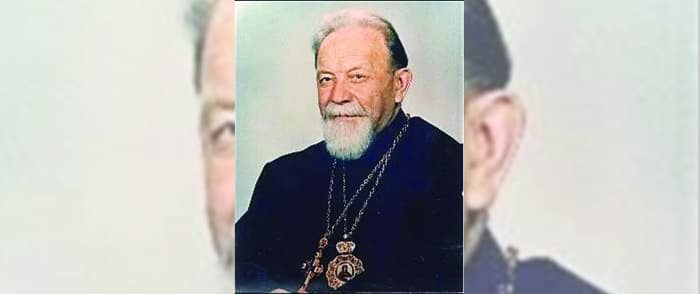
The child, Vasyl Vsevolod Velychkovsky, was born June 1, 1903, in what is now Ivano-Frankivsk, a diverse community with Polish, Russian and Jewish influences. IvanoFrankivsk is located in the western Ukraine in the foothills of the Carpathian Mountains close to Lviv. He was ordained to the priesthood on October 9, 1925, in Zboisk near Lviv in Ukraine at the age of twenty-two.
After World War I, the Peace Treaty of Versailles 1919, provided for the re-emergence of Poland as a sovereign state that became known as the Second Polish Republic. Between 1918 and 1939 Western Ukraine was incorporated into the Second Polish Republic. This created serious resentments and tensions in the region as a volatile mix of Polish, Ukrainian and Jewish populations struggled to gain control of their own destinies. As Father Vasyl began his ministry within this conflicted environment his work was fraught with unrelenting stress and pressure from the very beginning.
This was the reality for the next 16 years of his priesthood but by 1939 change was in the wind.
On August 23, 1939, Nazi Germany, positioning itself for the coming war, signed an agreement with the Soviet Union known as the Molotov-Ribbentrop Pact. The treaty was signed by Vyacheslav Molotov, the Soviet Foreign Minister and Joachim von Ribbentrop, the German Foreign Minister.
This agreement had a secret protocol that divided Eastern Europe into German and Soviet spheres of influence. On September 1, 1939, Germany attacked Poland from the west and very soon after the Soviet Union attacked Poland from the east and World War II began. By October 6, 1939, Poland was crushed and the Soviet Union was in control of territory stretching to the Bug River.
From this time on, Stalinist oppression became policy in Ukraine. Under this policy the Soviet focus was to eliminate any possible source of opposition to soviet rule. The lawyer Raphael Lemkin (1900 –1959) explained this strategy in the following manner: “… attacking the church was targeting the soul of Ukraine, attacking the intelligentsia was targeting its mind and starving the peasantry aimed to destroy the national idea, as they were the primary bearers of Ukrainian culture and language.”
The political repression unleashed by Stalin and his soviet government in the fall of 1939, was terrifying, hateful and relentless. Young Father Vasyl faced a nasty grind of daily oppression as the Ukrainian Greek Catholic Church, its bishops, its priests and its people were caught squarely in the crosshairs of the effort to Russify Ukraine. All of their fabricated charges and purges took an enormous toll on the emotional, spiritual and mental health of the people affecting their well-being for many years afterwards.
In June 1941 Germany, hungry for lebensraum (living space) and looking for Jews, invaded the Soviet Union in a surprise attack. During this invasion Germany quickly occupied large parts of Ukraine including Kyiv, Odesa and Lviv. The German occupation quickly became brutal featuring an organized and systemic exploitation of Ukrainian resources – one more period of time when the country and its people were subjected to conditions of war, murder, betrayal and nation-wide suffering.
It is estimated that over 5 million Ukrainian civilians were killed during World War II – among them, 1.5 million Jews. It was also during this time of German occupation that between September 29 and 30, 1941, more than 33,000 Jews, Roma and Soviet prisoners of war were murdered in a ravine known as Babi Yar located on the outskirts of Kyiv. One historian referred to this event as “… the single greatest atrocity on the eastern front:”
Large scale killings were also carried out by the Nazis in Odessa and the district of Lublin. The fact was that during the period of the Second World War, Ukraine became the principal battleground on the Eastern Front. Yet despite these conditions of war in the midst of killings, atrocities, hunger and exploitation, Father Vasyl continued to carry out his ministry of serving anyone who needed his help.
To be continued next month . . .
To find out more about St. Joseph’s Ukrainian Catholic Church click here.