
Random Notes by Trudy Schroeder
I recently enjoyed a performance of The Last Wife by playwright Kate Hennig at the Royal Manitoba Theatre Centre. The play presents the story of Kate Parr (1512-1548) who was the sixth and last wife of King Henry VIII. As good theatre is intended to do, the play caught my attention and inspired further thinking about the pivotal role that seemingly secondary characters can play in history.
The play presents Kate Parr as a beautiful, bright, educated, kind, and wise woman, who entered marriage with King Henry with great trepidation. But she was determined to set the boundaries for a different type of relationship for herself, the king, and his three children, Prince Edward, Princess Mary and Princess Elizabeth.
Her role in educating Edward and Elizabeth, as well as her role in encouraging Henry’s passing of the Third Succession Act of 1543 restored princesses Mary and Elizabeth to the line of succession to the throne proved to have significant historical impact.
The worlds of power and politics have always been complicated and dangerous, and even more difficult for women, whose role in the family and the broader world was so limited by the social, religious, and legal systems of the day. There is a point in the play after the death of King Henry where the young princesses ask, “What will we do now?” Kate Parr responds, “We will make history.”
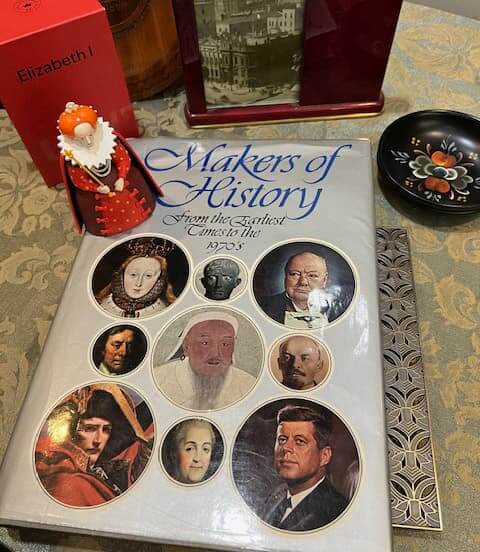
This part of the play has been buzzing about in my mind for days, and it has made me recall a Christmas gift I received from my father when I was in high school. I was very interested in history and historical fiction at the time. He gave me a book titled Makers of History from the Earliest Times to the 1970s. It is a very well-presented scan over the millennia to highlight people whose lives and decisions or inventions had a transformative effect on human history.
I can remember reading through the book with great interest, and I can also remember my dismay in finding that virtually all the people identified as the “Makers of History” were men. The book was well done, and the historical information was interesting, but it was the first time that I registered that the makers of history, with the exceptions of Queen Elizabeth I, Catherine the Great, Elizabeth II, and Golda Meir, were men. It was a shocking moment!
It simply does not make sense that half the population of the earth through thousands of years of human history has been relegated to a supporting role to stories that took place in rooms and on battlefields that they could not access.
As I look at the achievements and accomplishments of present-day women in science, business, politics, academics, the arts, literature, and sports, I am filled with thankfulness for the brave women whose persistence and excellence opened doors of opportunity so that women around the world could become active players and use all their skills and talents in making history. I firmly believe that our human story is improved when all people can fully participate in the sectors of society that fit best with their talents, skills, education, and interests.
This is an example of the ways that encounters we have with ideas and values in art, theatre, and music can inspire personal reflection and challenge our plans.
Trudy Schroeder provides project planning and management services to the community through Arts and Heritage Solutions.
To go back to the Main Page, click here.