
By Marianne Cerilli
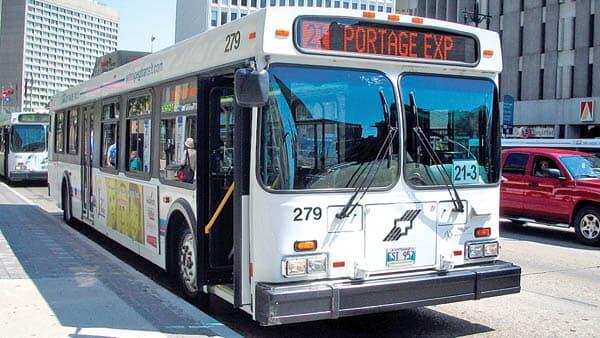
The Facebook group Winnipeggers Against the New Transit System now has about 13,000 members. People sharing stories of missed job interviews, even job loss because Winnipeg Transit system is so unreliable, with buses always late, or too full to board. It is so bad, bus ridership is down by $18.4 million in fare revenue this year.
Understandably, many people want their bus stop back and their route returned for a safer trip especially on rapid transit that does not go through empty parking lots in industrial zones with no one around.
However, there’s a larger context often missing in the concern about the decades of transit under funding of the old system and new system, with no net buses added and it’s why the Transportation and Land Use Coalition (TLUC) exists. You can’t build a functional transit system that’s efficient, affordable, safe, and reliable in a city designed for cars, or even larger gas guzzling personal vehicles.
The TLUC logo captures our challenge. It’s an image of Winnipeg from 1971 at 180 square km with a population of a 535,100, superimposed on a map of the city’s footprint in the 2020s at about 335 square km with 845,000 people.
This story of Winnipeg shows we’ve grown by 86 percent in land used, with only by 58 percent in population. That is roughly a 20% increase in land area costs per taxpayer. Kilometers more roads, sewer pipes, streetlights and other infrastructure, but a relatively smaller tax base paying, has meant cuts to most city services, including transit.
Additionally, most homes constructed have been single-family homes in new subdivisions spreading out towards the Perimeter Highway.
Between 2020 and 2025 there were about 54,000 new housing units built in Winnipeg, and although more infill housing is being built in Winnipeg, too much housing construction is still low density, single-family units in car dependant suburbs.
The problem is carbon emissions from car dependant neighbourhoods is far more than transit-oriented ones. Forty cars traveling 15 km emits 85% more pollution than one bus carrying 40 people. This pollution and traffic congestion remain highly subsidized while transit fares have increased 70 percent more than inflation, going from $.25 to $3.45 since 1972, with Winnipeg Transit more reliant on fare revenue than transit in other Canadian cities.
We need new leadership now to design and develop our city and transportation for energy efficiency. We can’t shift modes of transportation with 50% more people taking the bus, like our Transportation Mater Plan say, without changing our approach to urban design, and development.
This is why TLUC is now focused on organizing transit users to become a constituency of informed voters for a healthy city. All Winnipeg voters must ensure urban development and mode shift is a vote determining issue in the October 2026 election. Transit organization in Toronto and Vancouver have become powerful drivers for mode shift, smart development and healthier cities. EVs can’t do it, they may reduce emissions, but they do not reduce traffic.
The way to reduce traffic congestion, is more people on public transit, or bikes or even carpooling. So, drivers concerned about traffic should also support transit not road expansion.
This efficient vision for Winnipeg, therefore, rejects the proposal for Chief Peguis Trail highway expansion, at a likely construction cost of $1 billion and rejects Kenaston widening. The land use and transportation mode shift vision means no new highways or subdivisions until Winnipeg’s infill capacity for development is realized. Including a return on the investment into the bus rapid transit corridor with the mixed use, and mixed income development it was meant for.
Winnipeg must plan better and stop making costly mistakes like building the city outward instead of removing the rail yards under the Arlington Bridge, then replacing a bridge that should be torn down. It is important to know replacement of Arlington Bridge costs about as much as rehabilitating the land under the bridge. But development on the rail land is a tax generating engine by a new neighbourhood linking the North End to downtown.
Of course, rail relocation should’ve been done in the 80s and 90s after it was studied in the 70s, but the pressure from the heavy construction industry, home building, development companies and car sector even then was a constituency more powerful than our understaffed city planning department.
The other missing piece of this sustainable vision is inclusionary zoning to ensure that 10 to 20 percent of all new housing construction in Winnipeg is deeply affordable, rent gear income housing. It is not enough to build higher density housing, we must address our homeless crisis, as exemplified by the wait list demand for Manitoba Housing, growing since the 1980s to over 8000 families now.
We need candidates in the October election that understand this vision of a healthy city and take Winnipeg in the direction of cities around the world that are efficient, transit oriented, climate smart, equitable, resilient and deeply democratic.
Marianne Cerilli is an educator, and former MLA working in community development and social innovation. Listen to Marion on CKUW radio, or check out her website at Mariannecerilli.ca.