
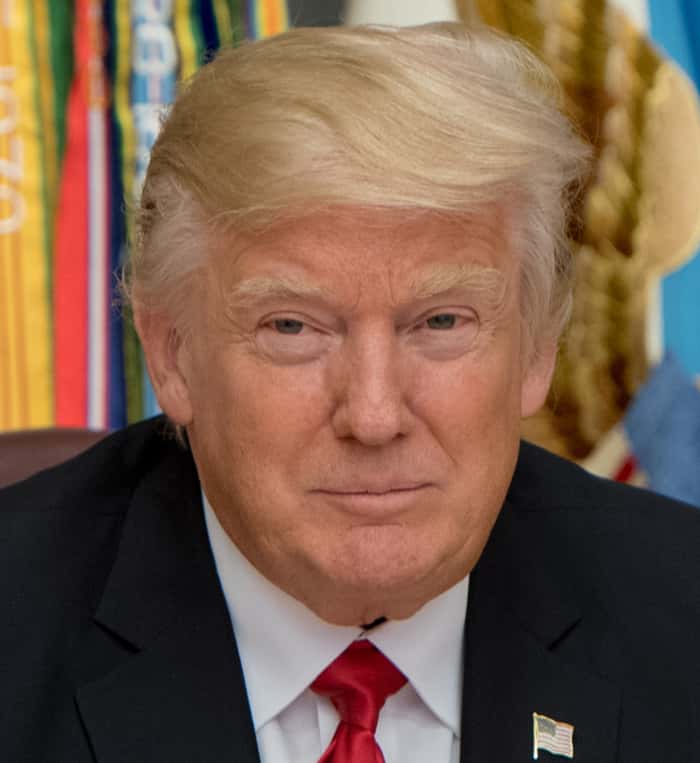
How to handle Donald Trump
By Dorothy Dobbie
Is Donald Trump a human being or some kind of ogre risen from the swamps of Florida?
Let’s take a hard, critical look at the guy. He has no horns; his feet are not cloven. He has only one tongue. When you poke him, he flinches.
Despite apparent evidence to the contrary, he is just a mortal man. Given that fact, we should be able to determine how to deal with him.
First, his appearance: tall – over 6 feet – good-looking as a young man with a wide, often closed-mouth smile. So far, so good.
Never smoked or boozed. Has a bachelor’s degree in economics.
Always had more money than most of us. Married to three different beautiful women. Has five kids – three men, two women, plus 10 grandchildren. He has a warm relationship with them overall.
He was born in 1946, so he is 80 years old now. Today, he has reddish skin and he sports blondish-reddish hair, the colouring of both apparently due to artificial aids. Is that a clue to his personality? A bit of vanity, perhaps?
But there are other clues, too. His frequent bragging, saying things such as “Nobody knows more about (fill in the blank) than me”, or bragging about his presidential accomplishments, saying that he had done things “that no other president could do”.
These are habits of people who are deeply insecure and need to overcompensate to cover up a sense of inadequacy. They need acknowledgement (Oh, good for you) followed by the introduction of a new topic to move the agenda forward.
Trump is often accused of being a narcissist, but is he driven by narcissism or insecurity? His frequent reversals seem to point to the latter. Remember, he is called TACO, an acronym for Trump Always Chickens Out. That seems to fit the profile.
Is he a narcissist? Many people think he is, but on closer examination of his character, I am not so sure. His actions seem to speak of a lost kid on the playground, not fully mature, trying to measure up and failing. He bullies weaker kids to cover this up.
Is that why he cheats in business? Maybe. Perhaps his need for validation outweighs every other consideration.
I am not a psychologist, obviously, but observing him and talking to people who know him, and reading his book and others about him, there seems to be a manageable animal on the other side of the table.
First is his constant need for validation. What does it cost to give it to him? Nothing. Smile, nod, agree. And persist with your point. “I would love to do what you ask, but here is why I can’t – what other approach do you think we could find to reach our mutual goals?” Or “Yes, of course, I see your point of view. What if we try it this way?” No need to make a significant adjustment to your offer – just frame it differently.
Some of you will be wanting to tell me to give my head a shake. Why do I think an unreasonable man of his kind would be affected by this treatment? But that’s the reason.
Because he is just a man.
Of course, it is more difficult if you are not in the same room and if others are making your deals for you. But why accept that? Let the negotiators do their thing. Thank them and then seal the deal one-on-one. “Nobody can see reason the way you can. So here are some sticking points which I am sure you and I can solve together.”
One of the things that struck me about the broken deal was the number of apparently serious issues and the kind of detail Carney came out with. That struck a false note right away. Nobody says, “We have a deal!” then completely rehashes the whole thing, including all the details, two hours later. Deals broken at the last minute come down to one, maybe two points at the most.
This is perhaps why some are saying Carney didn’t want a deal in the first place. That he deliberately broke this off to support his by-election prospects by looking like the “strong man”.
Regardless, I am sure of one thing: Donald Trump is run by his ego.
Carney’s constant public put-downs must rankle. They certainly do not encourage stronger relations and friendship.
So why is Carney doing this? Well, he apparently is also run by his ego. In many ways, he and Trump are a lot alike. They both have an insatiable need to be the biggest, best, smartest.
Trump believes he can win by virtue of being bigger, taller, and having more cards. Carney thinks he can win because he believes he can win even though he is smaller, shorter and less powerful, by stealth – by seeking to divide the world with the US as the bad guy (the Davos speech), and by using that to leverage new allies (Europe). (I think his China foray will fail.)
If Carney really wanted a deal, I am sure there is one to be had.
Despite all the posturing on both sides, this pointless strategy of ridiculous tariffs and counter-tariffs can only hurt them individually in the long run as their countries run out of patience, sick of being the pawns in a zero-sum game.
What will happen now? I cannot imagine that they will not get back to the table sometime after the by-election – maybe even as late as November after the midterms. I dread to think of what will happen if Trump wins them.
What to do about Donald Trump
By Shauna Dobbie
The question this month is what Canada should do about Donald Trump. I have been giving this serious thought, which was probably my first mistake.
Questions normally have answers. This one has Friday.
Canada could agree to every American demand presented on Thursday and discover on Friday that the numbers have changed, another grievance has appeared or the agreement itself proves that we’ve been taking advantage of the United States all along.
That makes the situation absurd in the proper sense of the word. We are being asked to solve a problem that depends upon remaining unsolved.
Trump says the US should not have a trade deficit with Canada.
That sounds straightforward until you look at what we sell.
In 2025, Canada sold the United States $126.1 billion in crude oil and bought $13.2 billion in American crude. That is not evidence of Canadian trickery.
Canada has oil. American refineries want it. Pipelines connect the producers with the refineries, and businesses on both sides make money from the arrangement.
If the trade imbalance is the problem, Canada has an obvious solution: sell the Americans less oil.
That isn’t what Trump wants. He wants Canada to sell fewer goods to the United States, except for the oil, natural gas, electricity, uranium, potash and critical minerals Americans need.
Apparently, resources stop counting as Canadian exports once the United States becomes accustomed to receiving them.
Then there are automobiles.
For decades, governments and manufacturers deliberately built an integrated North American auto industry. A vehicle may contain an engine from one country, a transmission from another and components that cross the border several times before the finished vehicle reaches a dealership.
This was not a Canadian plot carried out under cover of darkness. It began with the 1965 Auto Pact, expanded under NAFTA and continued under CUSMA, an agreement Trump himself negotiated, praised and signed.
Now the same integrated supply chain is presented as evidence that Canada has stolen American manufacturing. The proposed remedy is to force more production in the United States, even though American automakers warn that tariffs on Canadian components will raise their costs.
Trump is defending the auto companies by making it more expensive for them to build cars.
Maybe they’ll send him a thank-you note once they finish recalculating the price of a pickup truck.
American negotiators also want US liquor returned to Canadian shelves. That is not within Federal purview. Carney can ask the premiers to do that. He cannot order them any more than Trump can order US dry counties to sell liquor at all.
The language dispute is equally peculiar. The United States requires certain information on many imported products to appear in English.
Canada requires certain consumer information in English and French. That costs American exporters money. It’s the cost of doing business.
It is crazy to pretend that language requirements are an outrageous interference with trade. The American position appears to be that consumers have a right to understand a label when the language is English, but that the same principle becomes protectionism when the language is French.
American negotiators also object to Canada’s so-called cultural protectionism, including rules requiring large online streaming services operating here to contribute to Canadian programming. The burden falls heavily on American companies.
But those companies earn money from Canadian subscribers while competing with Canadian broadcasters that have long been required to help finance Canadian work.
Canada is hardly alone. The European Union requires streaming catalogues to contain at least 30 percent European works and requires those works to be given prominence. France requires subscription streaming services to invest at least 20 percent of their French revenue in European and French-language productions.
Canada’s system of public broadcasting, broadcaster obligations, tax credits and the Canada Media Fund helped make Schitt’s Creek, North of North and Heated Rivalry possible. Netflix helped turn Schitt’s Creek into a global phenomenon and co-commissioned North of North; HBO Max took Heated Rivalry abroad. These are not obscure programs being kept alive for our own good. They are Canadian shows that audiences elsewhere really want to watch.
The United States can reasonably argue about contribution rates or how the rules are applied.
Demanding that Canada abandon cultural protections is something else. A country of 41 million people living beside Hollywood will not preserve its own voice by hoping the algorithm feels charitable.
Ottawa was reportedly also expected to accept restrictions affecting Canada’s future trade agreements with other countries.
In other words, we should reduce our dependence on the United States, but not by trading too freely with anyone else.
It’s natural to assume that Trump has an ultimate objective, that if Canada can identify it and make the right concession, perhaps normal relations will resume.
It doesn’t work that way. Trump wants every relationship to remain a contest that only he can settle, reopen or escalate.
A durable agreement would limit his leverage. An unstable agreement allows him to demand another concession whenever he wants attention, political advantage or a new headline to take attention away from something like the Epstein files.
That does not mean Canada should refuse ever to speak with him. It means we should stop treating negotiations as a search for the combination of concessions that will finally make him satisfied. There is no such combination. Canada can’t solve Donald Trump.
And yet we must deal with his presidency.
That means building trade relationships elsewhere, strengthening energy links within Canada and transportation links to the rest of the world, developing more capacity to process our own resources and helping affected industries survive the disruption.
We need to insist that access to Canadian energy is part of the broader relationship, not an unconditional American entitlement.
Sometimes it may mean retaliating, but only where retaliation creates useful American pressure. We can’t put tariffs on American goods just for the (undeniable) emotional satisfaction.
Carney has suspended negotiations while leaving open the possibility that useful talks could resume. That is about right.
Leave the door open but stop standing in it with a cheese tray.
If Washington eventually proposes an agreement that respects Canadian sovereignty and offers something reasonably durable, we can discuss it. Until then, Canada should concentrate on becoming more difficult to bully.
That is not an answer to the question of what to do about Trump. There probably is no answer that will make him predictable, satisfied or harmless.
It is an answer to the question we can actually control: what Canada should do about Canada.