

By Hannah McLandress, Student, CentrePort Canada Inc.
Standing in the hangar at the STARS Manitoba base, the alarm blares as a call comes over the radio: a patient in western Manitoba may need transport to Winnipeg’s Health Sciences Centre.
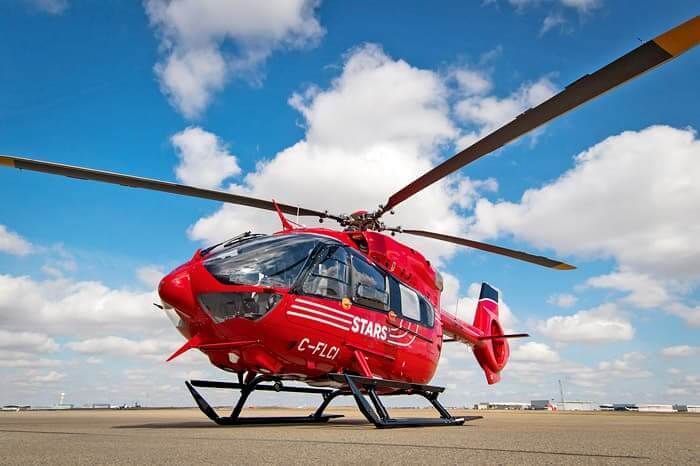
The fire engine red medical helicopter sits in the hangar. It’s one of ten in the STARS fleet; one of which is assigned to each of the six bases: Grande Prairie, Edmonton, Calgary, Saskatoon, Regina, and Winnipeg, while the other four serve as backups. The Shock Trauma Air Rescue Service’s (STARS) Manitoba base sits within CentrePort Canada’s 20,000-acre footprint on the Winnipeg Airports Authority campus.
The patient in western Manitoba is being assessed by their local medical team, so STARS is on standby. While they wait for the go-ahead, they start getting the helicopter ready.
Even though every call is different, the preparation is the same: the medical team checks the equipment and grabs anything specialized, and the pilots do a weather check to make sure the helicopter can travel safely and prepare for takeoff. When official dispatch calls come through, the team and the helicopter are ready to go in as little as 10 minutes.
Each time the STARS team takes off, there are two pilots, a nurse, and a paramedic on board. Every mission is directed by a transport physician, who can ride along when needed. Inside the helicopter is a fully stocked mobile intensive care unit with portable versions of standard emergency room equipment. Most of it is retrofitted to attach to the helicopter’s walls, and all within reach of the medical team.
STARS’ Manitoba base is the busiest of the six, with the helicopter flying an average of 800 missions per year. STARS is called for critical emergencies such as highway traffic collisions or farm equipment accidents, and transport calls to bring patients from rural health facilities to the nearest trauma centre.
“The work they do is incredible,” said STARS Manitoba development officer Madeline Wieler. “Our teams are extraordinarily skilled and can deliver care wherever our patients need it – in the air, on the side of the highway, or in ditches,” she said.
In Manitoba, STARS has a team of over 50 professionals including pilots, nurses, paramedics, and one accredited facility dog, Orion, who provides emotional support to all of STARS’ team members.
“The teams come back having seen some pretty heavy stuff,” said Madeline. “Orion is here to help relieve some of that pressure.”
As the hangar doors open, the nearby construction adds to the background noise. At the Winnipeg Richardson International Airport, the YWG West Lands development has begun. It will create over 200 acres of airside, shovel-ready industrial land for businesses requiring runway access and multimodal connectivity.
At STARS, the base is expanding after 14 years in operation to include a state-of-the-art medical simulation lab and additional spaces for staff and equipment.
“It’s really exciting,” said STARS Manitoba provincial director Grant Therrien. “Not just our expansion, but the development all around us, too. When we first opened, there wasn’t much happening on this side of the airport, but because of CentrePort, the development increased and continues to,” he said.
As a charitable not-for-profit, STARS relies on government, businesses and community funding to keep its bases fully operational. STARS works closely with local first responders, including the RM of Rosser Fire Department, to serve southern Manitoba.
“STARS has an incredibly important role in saving lives in rural Manitoba,” said Mike Palmer, Deputy Reeve of the RM of Rosser and chief of the Rosser Fire Department. “Without them, those outcomes would’ve been very different.”
The Rosser Fire Department and STARS Manitoba have a longstanding relationship; Mike and his team have assisted STARS pilots in training exercises to ensure they’re fully accredited.
STARS is also linked with Manitoba’s Virtual Emergency Care and Transfer Resource Services (VECTRS) and Keewatinohk Inniniw Minoayawin Inc. to reach patients in northern Manitoba.
“Anyone in a rural community knows who STARS is because we’re a lifeline when someone in their community needs critical care,” said Madeline. “As we’ve established ourselves here in Manitoba, it’s fantastic to see that folks who live in the city also recognize that we’re there for them when they need us.”
Another message comes over the radio: The potential mission to western Manitoba has been called off, so the crew takes a breath. Their day isn’t over though; there’s a little over three hours until their shift ends, and the next call could come through at any time.
“We’re grateful to be part of CentrePort,” said Grant. “They’re making a strong commitment to Manitoba, and we are too.”