
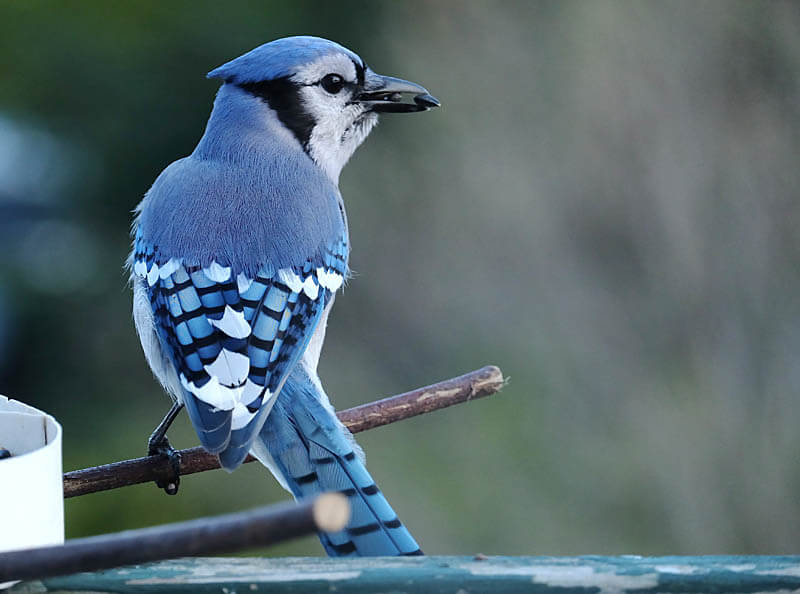
The blue jay is one of the most popular and widely recognized backyard birds. This bird is colourful not only in appearance but also in character. A highly entertaining creature, it visits birdfeeders in every season and can be heard throughout the neighbourhood as it announces its presence. You can easily attract blue jays to your backyard with the right foods and feeders, and you will be greatly rewarded with their antics. Several years after their population was first affected by the West Nile virus, they seem to have made a great comeback and been the star attraction in many backyards.
The blue jay’s range is vast throughout North America, as they breed in both deciduous and coniferous forests. They are most easily identified by their bright blue plumage accented with a black collar around their neck and a white chest. The male and female are identical in appearance. Breeding season is from mid-April to late July; nests are built in almost any tree, but evergreens are their preference. The nest is perfectly constructed with an array of materials like twigs, bark, moss, cloth, paper and mud. Three to six eggs are laid and hatch in 16 to 18 days, and the young fledge the nest 17 to 21 days later. The family stays together, as the young are taught to forage for food until early fall, when the parents force them to disperse.
Blue jays are very vocal and have several calls. They have a loud scream-like call and a calm, almost warble-like sound. They are also renowned for mimicking the sounds of other birds, hawks in particular. Other vocalizations usually go with a particular situation, such as one that indicates agitation and another that brings neighbourhood blue jays together to chase away hawks and other predators from the area.
A few key factors should be considered by homeowners wanting to attract blue jays to their birdfeeders. One is the size of jays. They are much larger than most feeder birds, so an appropriate-sized feeder is important. A platform feeder is ideal as it is an open-style feeder and easy to land on. There are many versions of this feeder; some even have roofs to help keep snow off in winter.
Blue jays like a variety of foods, like striped and black-oil sunflower, cracked corn and peanuts, their absolute favourite. Unsalted peanuts in the shell is the ultimate treat for jays; the peanuts can be offered on the platform feeder, or there are actual feeders that dispense the nuts. A peanut feeder will also attract woodpeckers, nuthatches and chickadees: they cling to the feeder to chip away at the shell to uncover a nutty treat. This allows for great viewing pleasure, as all the birds spend time at the feeder while they work at the peanuts.
Other blue jay favourites include dried corn on the cob and seed blocks, which are compressed cakes of nuts, seeds and fruits. There are feeders available to offer all these foods and most will attract more than just blue jays.
Blue jays are sometimes viewed as being aggressive at feeders, as most birds scatter when they arrive. As with all creatures in nature there is a hierarchy and blue jays are high up in the songbird world. They will not keep other birds from your feeding stations but rather aid in attracting with their calls. They also have a reputation for raiding nests of eggs or chicks, but studies show this accounts for a mere one per cent of their diet.
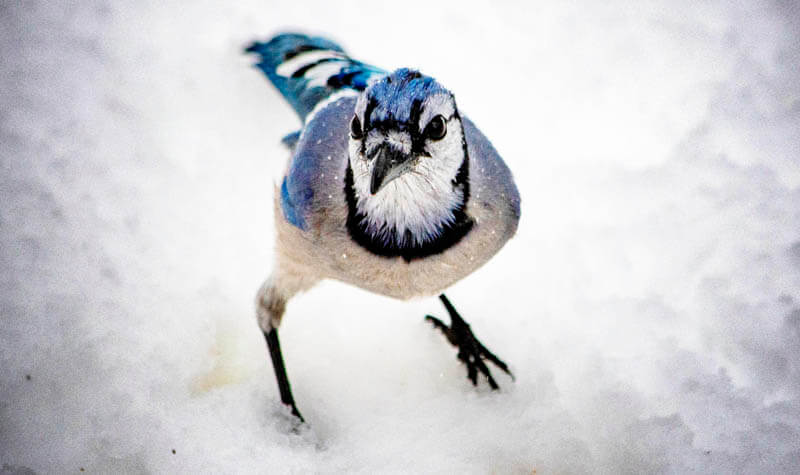
Some interesting facts on blue jays:
- They are monogamous pairs that bond for life
- The blue jay is the provincial bird for Prince Edward Island
- The oldest known blue jay was a captive bird that lived 26 years. The common wild age is about 7 years but one was recorded via leg-banding records to have lived over 17 years.
- Their feathers are not actually blue! The unique structure of the feathers reflect light and appear blue. If you were to crush a feather and damage that structure, the blue colour would change to brown.
- Their love of acorns has earned them credit for helping plant oak trees after the last glacial period
- The black bridle across the face and throat is different on each bird and is believed to help jays recognize each other. Have a closer look at your blue jays to see if you can spot a difference.
This season, take part in the entertaining world of feeding birds and let the only winter blues you experience be blue jays!
Sherrie Versluis owns The Preferred Perch on St. Mary’s Road. Call her at 204-257-3724.