
By Greg Barrett
Finale – Part 4 of 4
“Can a woman forget her nursing child, Or show no compassion for the Child of her womb? Even these may forget, Yet I will not forget you” (Isaiah 49:15)
This is where we left off in October:
When they arrived, Romolo was introduced to Bishop Velychkovsky by Maria who also translated. Romolo was immediately struck by how “very frail” the bishop appeared and by the fact that he projected a deep sadness.
Romolo and Vasyl looked at each other, and Romolo was mesmerized by the bishop’s eyes. There were tears in the bishop’s eyes and it was as if Romolo was able to take the measure of the man and recognize the pain and agony searing his heart. It seemed that Blessed Vasyl was sharing with Romolo the painful road that he had travelled for the past 47 years – Stalinist oppression; false accusations; fabricated charges; famine used as a weapon of subjugation; wartime conditions; hunger; atrocities; long-term imprisonment; constant and consistent pressure of being discovered; torture to the point of death; and at the end, exile. Bishop Velychovsky was clearly feeling the pain of a pastor ripped apart from his people and his flock in Ukraine and the pain was complex – part guilt, part frustration, part loneliness and part a sense of powerlessness. Romolo Fracassi was moved to his very core.
• • •
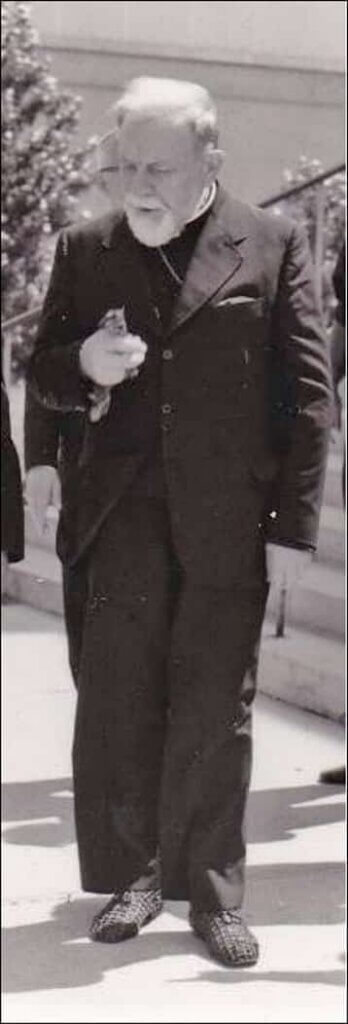
After the introductions were completed, the Saint and the Tailor began their work. Romolo came to the Chancery three times for fittings during the spring and summer of 1972 and while they worked, he and the bishop would talk.
Blessed Vasyl described his treatment by the Russians – the withholding of food, the beatings – and expressed his gratitude for the blessing of freedom. But at the same time, he was torn by the fact that he was “free” and his people were not.
The bishop described his joy when visiting the Matwichuk cottage at Ukrainian Park near Gimli in Manitoba during that summer of 1972 – standing by the lake as the sun shone down on his bare chest and feeling so thankful for his freedom. During the time of their brief relationship Bishop Vasyl teased Romolo about being Italian. He told him that when he was in Italy, he was told to watch out for the Italians – they are pretty tricky. They enjoyed a good laugh together and kept on working.
In the end Romolo made 2 suits, 1 sport coat; 2 pairs of pants and 1 overcoat. In all, there were three fitting sessions and by the end of the process Romolo was gratified to see Blessed Vasyl Velechkovsky’s eyes “sparkling”.
Over his career Romolo made many suits. Yet his work with Blessed Vasyl was not so much about clothes as it was about the strong spiritual connection with this man from the beginning of their short time together – so much so that he knew him instantly 50 years later.
Despite his condition as a “dead man walking”, Blessed Vasyl was not idle. He attended a clergy retreat, visited schools and celebrated Pontifical Divine Liturgy at Sts. Volodymyr and Olga Cathedral in Winnipeg. He visited Ukrainian Park in Manitoba and later in July he made visits to Yorkton and Saskatoon in Saskatchewan. Dr. Matwichuk was concerned enough with Blessed Vasyl’s schedule that he approached Father Michael Wiwchar who, in 1972, was the Director of St. Vladimir’s Minor Seminary in Roblin. He requested that the bishop be permitted to stay at St. Vladimir for a period of rest. He stayed in Roblin for about a week in August 1972.
In a recent interview, now Bishop Michael Wiwchar who was a first-hand witness to the damage done to Blessed Vasyl by his soviet torturers, related that Bishop Velychkovsky had difficulties with the rubrics of Divine Liturgy and asked him to take him through the liturgy step by step. Bishop Wiwchar saw this as clear evidence of the damage done to Blessed Vasyl – “… an intelligent person completely lost”.
In that same interview, Bishop Wiwchar revealed that on one occasion he escorted Blessed Vasyl on a flight from Winnipeg to Edmonton. During that flight they discussed a variety of issues and Bishop Michael came away from those discussions with the sense that Blessed Vasyl was afraid for his life fearing that the communists would try to “finish him off” even here in Canada.
He came back to Winnipeg and attended an evening at Folklorama and then went off to visit Newark, New Jersey, Philadelphia, Pennsylvania and New York. As time went on the bishop’s health deteriorated and at one point Dr. Matwichuk wanted to place him in the hospital. The bishop argued that his treatment should be at home.
Maria Matwichuk attributed this resistance to his terrible three-year imprisonment in the hospital in Ukraine. At one point in 1973 however, Bishop Velychkovsky was treated in
Misericordia hospital in Winnipeg. On that Winnipeg Archeparchy Priests’ Retreat occasion, Leonard Krawchuk, a student nurse was assigned to his care. When he met the bishop Leonard found that he was not very communicative.
In an effort to build a connection between himself and the bishop, he brought in a book from Soviet Ukraine. The book was actually an album of St. Sophia Cathedral in Ukraine. He showed the book to the bishop and they went through it together. The bishop didn’t say too much but Leonard was hoping that the book would be a bridge to building up the relationship between himself and the bishop. After a time, they put the album aside and Leonard went about preparing the bishop’s morning bath. It was at that time that the bishop left the ward and went down the stairway “trying to escape”.
Leonard went after him and after a prolonged time of persuading he got him to return to his room.
Later in that day Blessed Vasyl spoke to Dr. Matwichuk and explained to him that because the book was from “soviet Ukraine” he thought that Leonard was KGB, was afraid of him, didn’t want anything to do with him and tried to get away. Dr. Matwichuk explained Leonard’s role and function in the hospital.
This seemed to make things better but Leonard felt that Bishop Velychkovsky was “confused” and very sick. In retrospect, it is reasonable to draw the conclusion that because St. Sophia Cathedral was the Orthodox cathedral in Kyiv, bishop Vasyl would think that this is something that the KGB would do – after all, he had been resisting efforts to make him join the orthodox church for most of his priestly life which he would see as an instrument of Russian oppression.
When Bishop Velychkovsky arrived in Winnipeg in 1972, he had already endured 27 years of prison and torture and pastoring to an underground church in an uncertain and dangerous environment where informing on fellow citizens was a way of surviving and gaining favor with the Soviet authorities. So it was that at the age of 70, the bishop was admitted to Misericordia Hospital for, in the words of Dr. Jaroslaw Barwinsky, “progression of severe heart failure”.
On June 29, 1973, he suffered a “severe stroke” while eating his breakfast and early in the morning of June 30, 1973, succumbing to his wounds received under torture and the poisons injected into him, this “suffering servant” died a martyr’s death. His funeral took place on July 5, 1973 from Sts. Vladimir and Olha Ukrainian Catholic Cathedral in Winnipeg, Manitoba and he was buried in All Saints Cemetery.