
The Gardener by Dorothy Dobbie
Daylilies are now often the flower of choice for many former lily growers because the red lily beetle ignores them
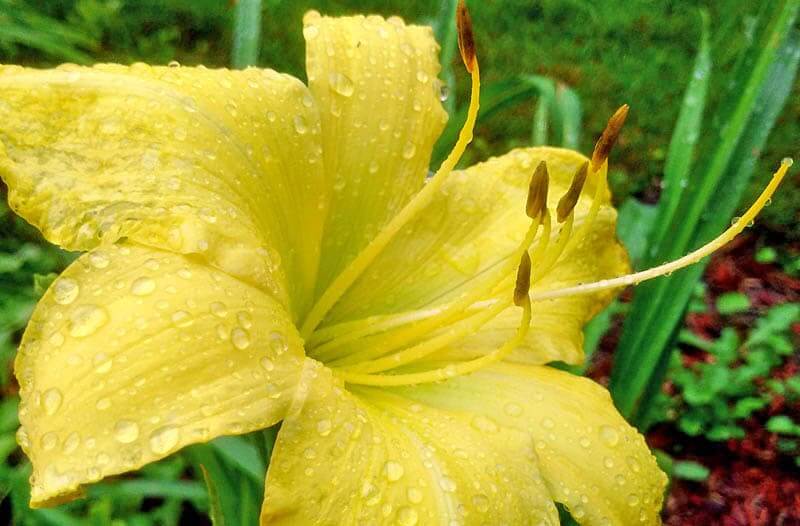
Beauty in living things is always ephemeral, but when it lasts for only one day, it seems all the more desirable. So it is with daylilies, or Hemerocallis, their botanical name. They produce a bloom that opens in the morning and fades within 24 hours, generally overnight, although there are species that flower at night.
Fortunately, daylily scapes, as the flower stem is called, have the ability to produce more than one bloom, the number depending on the variety.
Often the blossoms are fragrant, especially the night bloomers, and there are new hybrids that will even re-bloom, the most famous being Stella de Oro, a smaller daylily with narrow leaves and yellow flowers. There are now several other choices some of the newer cultivars will bloom for months.
Although at one time, daylilies were considered to be part of the lily family, they have since been removed to a group that is based on the flower stalk emerging from a basal rosette of leaves. The group includes Kniphofia (red hot pokers).
Daylilies have an interesting but perhaps little known trait in that they produce a miniature daylily called a “proliferation” at nodes along the flower scapes.
The proliferation can be planted and will produce an exact clone of its parent. The plants can also be propagated through root division and seeds.
Daylilies, like true lilies, are easy to hybridize. There are over 60,000 cultivars named and registered.
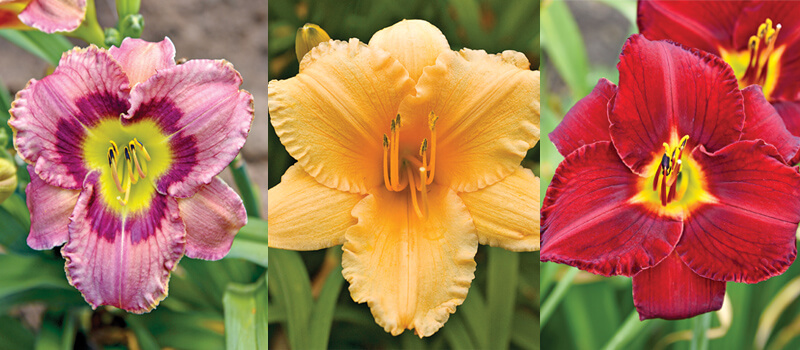
The flowers consist of three petals and three sepals, six stamens and a prominent, two-lobed anther. However, the variety of colour, shape and texture of the three petals is astonishing. They can be ruffled, recurved, long, slender and drooping, even doubled.
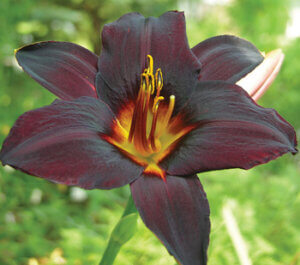
The colours can range from creamy white to orange, to red, to purple, to pink and cream and lemon yellow and all shades in between. Often they have a contrasting throat which can be dark or light or banded, watermarked, haloed, tipped, dotted or dusted or flecked. Petals can be edged in dark tones that mirror their throats. They can be diamond dusted, where tiny crystals in the cells of the plant reflect light creating an illusion of being dusted with sparkles. The variety is endless.
The most elusive colour is blue. While many varieties contain this colour as part of their name, I have never yet seen a true blue daylily. Don’t rely on photos, either; the colour has often been manipulated. What the marketers call blue is usually purple, mauve or even sometime pink.
Plant dark coloured daylilies in a partly shaded area to preserve their vibrant hues. Light colours do better in full sun.
Care for daylilies
Daylilies, a sun-loving plant that need about five to six hours of sunlight a day, grow happily pretty much anywhere. You can give them a boost in springtime by sprinkling low nitrogen, slow-release fertilizer (such as 5-10-10) in the root zone, about six inches away from the base of the plant. Water it in well. Mulching can help retain moisture in the soil and suppress weeds.
Don’t allow the re-bloomers to dry out as this can stress the plant and prevent re-blooming.
If you notice hard “buds” that will not bloom, these may be seed pods and should be removed to promote more blooms in re-blooming varieties and strengthen blooming capacity for regular varieties.
After planting, daylilies commonly take a while to establish and may not bloom or bloom well for the first two or three years, but be patient. They are well worth the wait.
To divide daylilies you can choose the long and complicated method of digging up the whole plant then carefully untangling their roots, or the easy method of using a sharp spade directed through the centre of the crown to divide the plant into four pieces, then dig each out separately. This is the easiest way to deal with a long established plant that has grown very large. Yes, this will damage some tubers, but if the daylily is very overgrown, this is small sacrifice to pay in terms of time and energy.
You can divide in either spring or fall, although in areas where there is a lot of clay, the spring time is the easier because the ground gives up its hold on the roots much more readily.
What’s all this about diploid and tetraploid?
Daylily aficionados often use the terms “diploid” or “tetraploid” to describe the different kinds of plant. Diploid refers to a plant with two separate sets of chromosomes. Diploids have 11 chromosomes from the egg cell and 11 from the sperm cells of its pollen which means that one set is inherited from each parent. Tetraploids have four sets or 44 chromosomes. You probably don’t give a hoot about this except to note that tetraploids often have larger blooms and diploids often display the prettiest pinks.
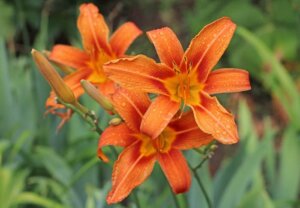
The dreaded orange or tawny daylily
New gardeners beware of friends offering daylily roots – chances are that this is the very prolific Hemerocallis fulva, an invasive species that travels via underground stolons, or roots that send out runners to start new plants. They are tough plants and will persist if even the smallest piece of roots is left in place. On the other hand, they are great for filling in vast empty space and will even out-compete goutweed.