
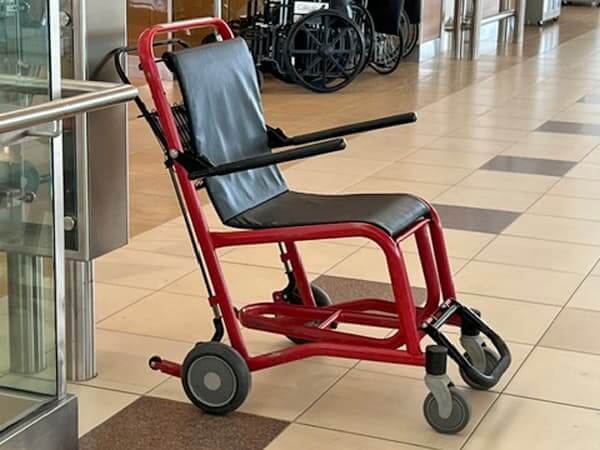
If you have had the opportunity and privilege of travelling internationally in recent years, you will have noticed that the services for people needing assistance in the airports has become much more evident. It seems that every time I travel, I see more people who are daunted by the logistics of getting around these massive airports. If you are travelling internationally and must move between terminal buildings, navigate the security processes and the customs and border control systems it can mean long waits in inexplicably slow lines, and hikes of miles of corridors with occasional moving sidewalks and then great expanses of walks.
Even the Winnipeg airport, which is not the largest of the airports you might encounter, can prove to be challenging to people with reduced mobility, recent surgery, or other health challenges. It seems that the gates for the most travelled routes from Winnipeg to Toronto or Ottawa are invariably at the gates furthest from the security checkpoint. This can prove to be more than many people can manage.
As you plan your trip and organize your travel arrangements, it is possible to indicate a need for airport assistance. The need for assistance is then included in your trip file and is indicated on your boarding pass. The accommodation this provides includes, in Winnipeg, access to an airport wheelchair and, if needed, the assistance of airline personnel to take you from the check in gate to your flight departure gate. This can be off immense service and aid to people who are no longer able to navigate these tasks without help.
Fortunately, the airport has a supply of quite interesting wheelchair and unaided wheelchair options that can make covering the distances possible for most people. The red metal chair in the attached photo is quite remarkably designed to make it quite possible for a relatively small-framed personnel member to move people of considerably larger size around the airport without significant hardship, while some of the more standard wheelchair options can be quite problematic.
It is also then possible to be in the group that can board the aircraft in an earlier group to have more time to reach the aircraft through the boarding gates, find seats, settle canes and other mobility devices, stow luggage, and clear the aisles before others board the plane.
Each airport has a different combination of wheelchairs, airline or airport assistance personnel, travel carts, buggies, and other types of conveyances. Generally, the assistance personnel are polite, helpful, and competent. The services they provide make it possible for people who have health issues to continue to travel to see family members, conduct business in other locations, and go on vacations. Occasionally the match up of people needing help and those able to provide that help is insufficient or the equipment available is not suitable to the needs of the traveller.
In busy airports, with travellers of every language and race and assistance personnel who are trying to help many people, sometimes those in need of help are moved to the side and abandoned like lost luggage. The looks of dismay and concern on the faces of these travellers and their travel companions is quite heart breaking.
With the very large number of baby boomers reaching ages where physical infirmity is more common, I fear that our airports, which are designed to accommodate those who can cover large distances with ease, will run into increasing challenges in providing services in a humane way. The time for a crisis is coming very close.
Last year I was booked on a flight to Amsterdam which also included a large contingent of Canadian veterans who had been part of the liberation of the Netherlands in World War II. The line of 20 or more wheelchairs each holding a veteran who was close to one hundred years old was quite a logistical feat for the airports and airlines. It was a special occasion, and the process was surprisingly efficient and well planned. For the next twenty years or so we will see increasing numbers of people needing that assistance, and we should be planning and advocating for those services to be developed to accommodate those needs.
Trudy Schroeder provides project planning and management services to the community through Arts and Heritage Solutions.