
There is a world of adventure in Manitoba. So many of us never get to experience it.
Do I sound like a travelogue? When I think of Manitoba, I feel like a travelogue – an enthusiastic one.
This year, instead of spending our money on some far-off destination. Why not take a tour of Manitoba? Not only will you discover awesome things you never imagined, but your kids will get an education that they will cherish forever. And you will be doing our economy an enormous favour!
Here is my imagined tour. You could break it up into many packages, including day trips, camping trips and two-week vacations. It takes you on an eventual journey to the far north, but lingers in the middle of Manitoba, the place where all the dreams of Manitoba’s future were begun. This land above the lakes was where commerce first happened and where the romance of a new land was woven, although eclipsed by what happened later at the junction of the Red and Assiniboine. But back in those early days, all the action was North of 53, from The Pas and up.
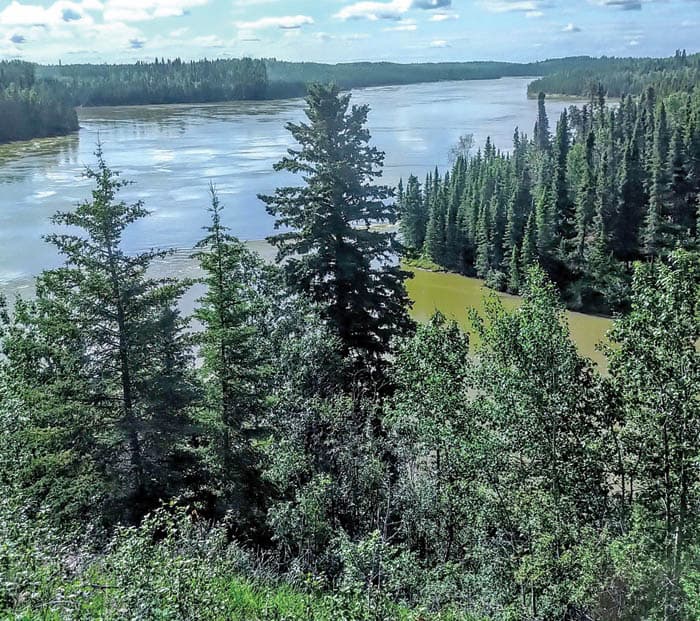
Travel north to Hudson Bay
We all talk about Churchill, but what we are really talking about is Hudson Bay, the magic and romance of the ocean on our northern borders. The focus is usually on polar bears, but a summer journey would include the amazing experience of visiting the “prairie” whales, the belugas that breed here at the mouth of the Churchill river in the tens of thousands. They are white above the water, but a fluorescent green beneath the surface. Their babies stick right beside the mamas as if they were attached.
Wally Daudrich of Lazy Bear Lodge has launched a wonderful new way to see them up close – a boat with underwater windows where you can share their world as you travel among them.
To get to Churchill, you can hop an expensive flight (quite luxurious – they serve you full meals) from Winnipeg for as low as $1,035 round trip.
Or you can drive to Thompson, then hop a train for under a hundred dollars one way if you can do without a berth. The train leaves around 5:00 p.m. and gets to Churchill about 9:00 the next morning.
I would drive. Take your time. Start by going Number 6 highway and north to Thompson. Come back through Snow Lake, Flin Flon and The Pas.
Steep Rock
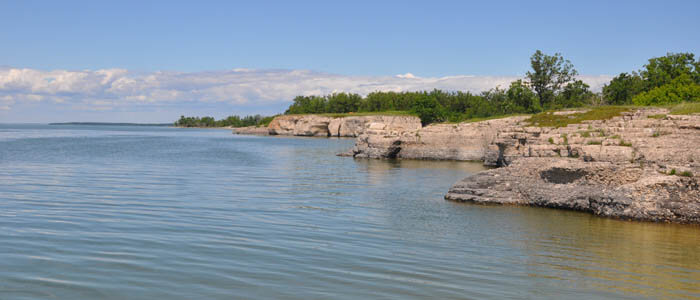
About 2.5 hours north of Winnipeg up Highway 6 to PTH 239 is Steep Rock, a tiny village on the shores of Lake Manitoba. It has been in place for over 100 years and even had a post office back in 1915. Canada Cement operated a quarry there in the thirties.
But the main attraction is the coastline itself. Limestone cliffs line the shore, leading to caves and hidden coves fronted by lovely little beaches. This is one of Manitoba’s most photographed places. There are lots of wildflowers and berries for the hiker. If you are camping – and given the lack of population in some of the places you are going, that option might be a good idea – there is a campground here and a government dock.
A little grocery store and café are also available where you can get a meal and charge your phone if you don’t have a car charger.
Grand Rapids
It is still a long way to Thompson. And it is a very long, smooth straight road. You will be tempted to speed, but the word is that the Mounties keep a pretty close eye on this road. You still have about five and a half hours to go to Thompson.
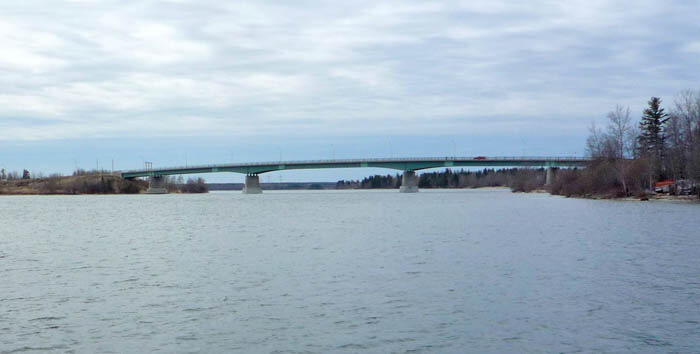
Grand Rapids is another two and a half hours from Steep Rock. It is located at the spot where the mighty Saskatchewan River empties into Lake Winnipeg. The terrain takes a steep drop of seventy feet over four miles, hence the rapids, which forced a portage when waterways were the main mode of transportation. La Verendrye established the short-lived Fort Bourbon here 1741, although the fort was moved in 1758 to what is now The Pas.
Grand Rapids has another special place in Manitoba history as the site of a couple of skirmishes in the Pemmican Wars between the Hudson Bay Company and the North West Company.
Grand Rapids has the distinction of being the first place in Western Canada to have a rail line. Built in 1877, the line was used as a portage to haul goods around the rapids on the river. The rapids are gone now, sacrificed to Manitoba Hydro construction in the 1960s.
Take in some of the historic sites and then and stock up on snacks at one of the two gas stations before you leave.
Thompson
Now you are in for the long haul as there is virtually nothing between you and Thompson for the next three and a half hours.
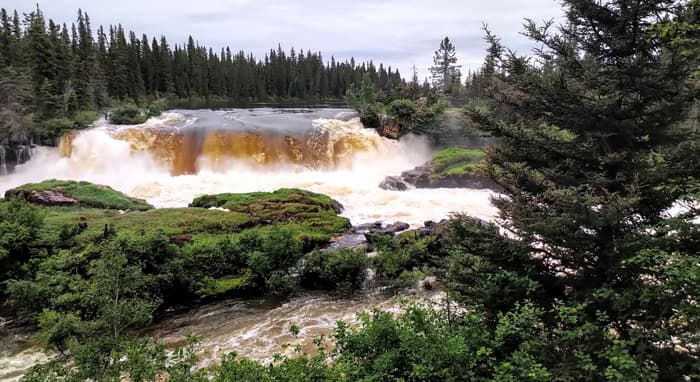
Be sure to take a side trip to spectacular Pisew Falls, 46 km south of Thompson, and the one of the province’s two largest waterfalls. Beautiful Paint Lake Park, off PTH 375 has a campground, if camping is your accommodation mode.
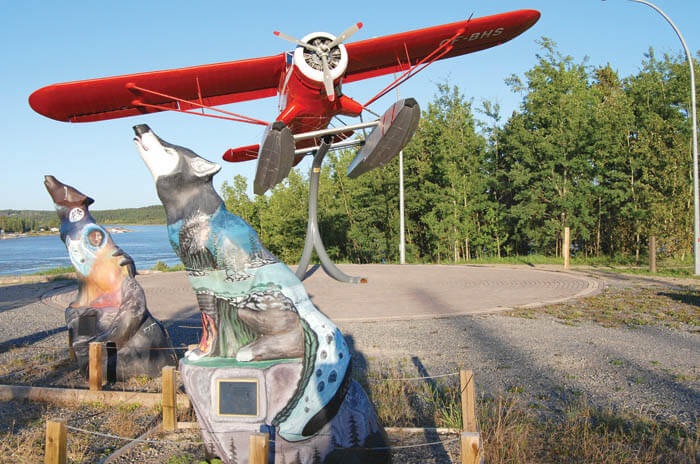
Once in Thompson, you may find yourself greeted by wolves – they are the city’s mascot and images of the howlers are everywhere. They line the Spirit Way walking-biking trail and their images adorn the walls of on the town’s high-rises and other buildings.
Thompson was the poster child of the nickel mining-smelting-refining world back in the sixties, the only integrated operation of its kind in the Western Hemisphere then. At the town’s peak, more than 4,000 worked in the operation. That has dwindled to around 800 today and the future of the mining industry seems in doubt, but the town has transformed into an administrative centre for this part of the north where it serves a trading population of around 50,000.
There are 20 restaurants and several shopping malls as well as 8 hotels if you didn’t opt for the campground, so spend the day exploring.
Next month, it’s off to Churchill. Get ready for the great visit.
• • •
To visit Travel Manitoba for more information on what to see in Manitoba’s north click here.